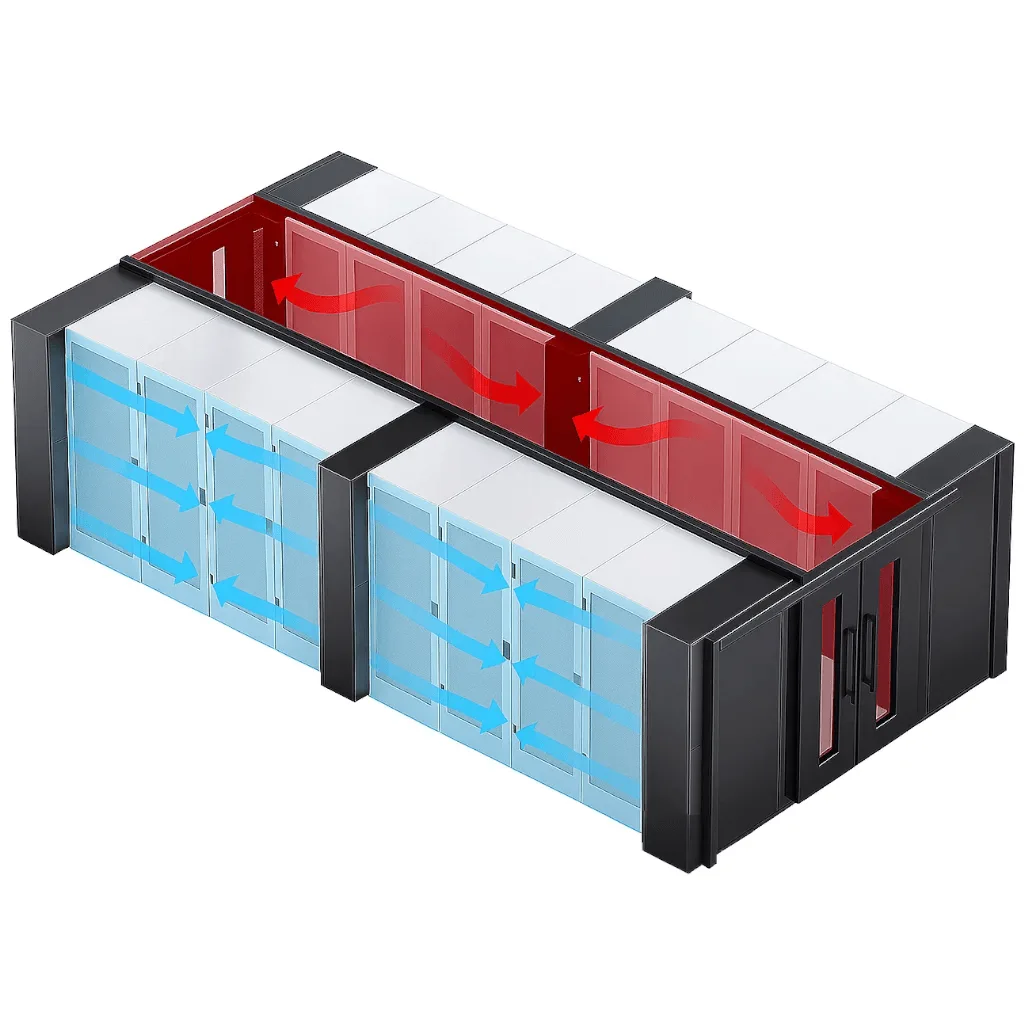
In server rooms that have grown over time, cold and warm air almost always mix. Racks face in different directions, gaps in the rows let cold air circulate without doing any work, and the cooling unit fights its own exhaust heat. The result is high operating costs alongside local hotspots – the cooling runs flat out even though, on paper, there would be enough capacity.
Containment solves this without additional cooling capacity. The cold aisle is enclosed, gaps in the rack rows are closed with blanking panels, and the airflow is directed. The cooling unit then cools exactly what needs cooling – rather than the whole room.
For many operators this is the measure with the best ratio of effort to effect, because it makes better use of existing equipment instead of buying new. And because it pushes back the point at which the existing cooling really does run out.
Where containment is the right choice
- When cooling is running at its limit What is often missing is not cooling capacity but its targeted delivery. Containment addresses exactly that.
- When hotspots occur Local temperature peaks despite nominally sufficient total cooling capacity are the classic symptom of mixed air streams.
- When energy costs are biting Over several years of operation, electricity is the largest single item in the total cost – well ahead of the purchase price.
- When no building work is wanted No intervention in the building fabric, no permits, and implementation is possible during live operation.
Key technical data
| Function | Separation of cold and warm air, directed airflow |
|---|---|
| Deployment | Existing server rooms and data centers |
| Effect | Higher cooling efficiency, lower energy costs, fewer hotspots |
| Scope | Containment, blanking panels, adjustment of the airflow |
| Building work | Not required |
| Operation | Can be implemented during live operation |
| Planning | Prior survey of rack layout and load distribution |
| Availability | Project-specific |
| Available as | Rental or purchase |
Standard equipment
These components are part of every system – all you provide is the footprint, a power connection and network access.
- Redundant precision cooling with environmentally friendly refrigerants
- Uninterruptible power supply (UPS), with a backup generator on request
- Early fire detection and suppression system
- Access control and remote monitoring via Smart Control
- Network connection via fiber, 5G or LTE
- Optional: server racks, cabling, PDUs and complete IT hardware
Typical deployment scenarios
- An existing server room with rising load and temperature problems
- Preparing for additional racks without expanding the cooling plant
- Reducing operating costs at an energy-inefficient existing site
- Eliminating local hotspots where total cooling capacity is sufficient
- As an addition to a modular data center at the same site
A quick test for your server room
Three questions reliably show whether containment is worthwhile. First: do all racks face the same aisle at the front? Second: are gaps in the rack rows and unused height units closed off with blanking panels? Third: is the return air temperature at the cooling unit well above the supply air temperature?
Anyone answering no twice is, as a rule, giving away measurable cooling capacity. The reason is always the same: cold air finds a way back to the cooling unit without having passed through a rack first. The unit then measures a return air temperature that is too low, throttles back – and the racks still get too little.
Have your server room efficiency assessed
We survey the rack layout, load distribution and temperatures and tell you what containment would deliver in your case – before you invest.
Frequently asked questions
Does operation have to be interrupted for the work?
As a rule, no. The containment is installed during live operation. The precondition is a prior survey of the rack layout and the load distribution, so that the airflow is designed correctly.
How far do energy costs fall?
That depends on the starting point and can only be quantified responsibly after a survey on site. The more cold and warm air have been mixing, the greater the effect. The difference between supply and return air temperature, together with the load on the cooling plant, gives a meaningful indication.
Do I also need a new cooling unit?
Usually not – that is the whole point of the measure. Containment makes better use of the cooling capacity already installed rather than requiring more. It frequently pushes back the point at which expanding the cooling plant becomes necessary at all.
Is this also suitable for small server rooms?
Yes. What matters is not the size but whether cold and warm air are mixing. Even in rooms with only a few racks, directed airflow and blanking panels can deliver a clear gain.
What is the difference between cold aisle and hot aisle containment?
With cold aisle containment, the aisle carrying the cold supply air is enclosed; with hot aisle containment, it is the aisle carrying the exhaust air. Which variant fits depends on the room geometry, the arrangement of the cooling units and the load distribution.