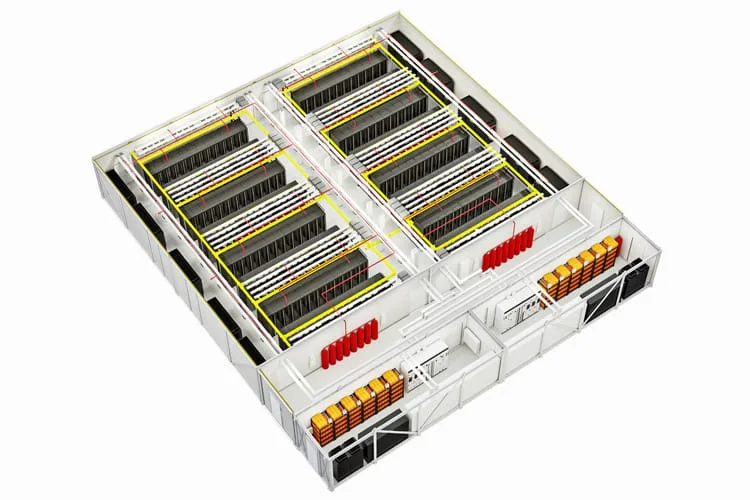
The MegaMod answers a structural problem: capacity requirements in the megawatt range arise faster than a data center can be built. Several years regularly pass between establishing the requirement and commissioning a new building – time in which, experience shows, the requirements change more than once.
The modular solution reverses the order. Instead of planning the final build stage in advance and constructing it in full, you start with the capacity you need today, from around 0.5 MW, and expand in stages as the load actually grows. Capital is committed only once the capacity is genuinely in use.
The MegaMod is deployed where computing power is the core business: at banks and insurers, in broadcasting, at telecommunications providers, in retail and in the oil and gas industry.
Where the MegaMod is the right choice
- When build time is the problem The capacity is ready in a fraction of the time a new-build project needs to reach commissioning.
- When the final build stage is open You do not commit to a target size that may no longer fit in three years, but expand in line with actual demand.
- When capital should not be tied up in advance Investment is made per build stage, not for the full final capacity up front.
- When computing power is the business For sectors in which availability feeds straight through to revenue, a fail-safe design is provided from the outset.
Key technical data
| IT capacity | 100 kW – 10 MW, in build stages from 0.5 MW |
|---|---|
| Construction | Modular design, expandable in stages |
| Cooling | Designed around the build stage, available redundantly |
| Power supply | Dedicated power supply, extendable with a PowerMod |
| Fire protection | Early fire detection with suppression system |
| Security | Access control, remote monitoring via Smart Control |
| Network connection | Fiber, 5G or LTE |
| Availability | Manufactured to order |
| Available as | Rental or purchase |
Explore the module in 3D
Standard equipment
These components are part of every system – all you provide is the footprint, a power connection and network access.
- Redundant precision cooling with environmentally friendly refrigerants
- Uninterruptible power supply (UPS), with a backup generator on request
- Early fire detection and suppression system
- Access control and remote monitoring via Smart Control
- Network connection via fiber, 5G or LTE
- Optional: server racks, cabling, PDUs and complete IT hardware
Typical deployment scenarios
- Establishing a new data center site without a multi-year build
- Expanding capacity at banks, insurers and telecommunications providers
- Data centers for broadcasting and media production
- Infrastructure for retail and logistics with rapidly growing data volumes
- Oil and gas industry sites with high demands on resilience
The real bottleneck is the grid connection
On projects of this scale, the time-critical path is rarely manufacturing but the power supply. A connected load in the megawatt range requires the grid operator to be involved, and the lead times for that run from months to years, depending on the region and the state of the network.
That is why this question belongs at the start of every project, not at the end. In many cases it is worth sizing the first build stages so that they can run on the connected load available today, and tying expansion to the grid upgrade. For the interim, supply can be secured with a PowerMod or a backup generator.
Talk through a MegaMod project
On projects of this size, the discussion starts with the available connected load and the timeframe. Get in touch – we will establish feasibility before we turn to configuration.
Frequently asked questions
From what size is a MegaMod worthwhile?
The entry point is around 0.5 MW, expandable in build stages up to 10 MW. Below that, a MaxiMod is usually the more economical choice, covering the range from 250 kW to 2 MW.
How does staged expansion work?
You start with the capacity you need today and add further modules as the load actually grows. The advantage over a new build: you do not have to fix the final build stage in advance, and capital is committed only once the capacity is in use.
What is the longest lead time in the project?
As a rule, the grid connection. Connected loads in the megawatt range require the grid operator to be involved, with lead times from months to years. This question should therefore be settled right at the start of the project, not at the end.
Can the MegaMod be operated before the grid upgrade is finished?
Yes. For the interim, supply can be secured with a PowerMod or a backup generator. The first build stages are often sized deliberately so that they run on the connected load already available.
Is an installation of this size also available to rent?
Yes, we offer both models. For a permanent requirement over several years, more usually speaks for buying – because of depreciation and full control over the infrastructure. For interim and project solutions, renting is often the better fit.