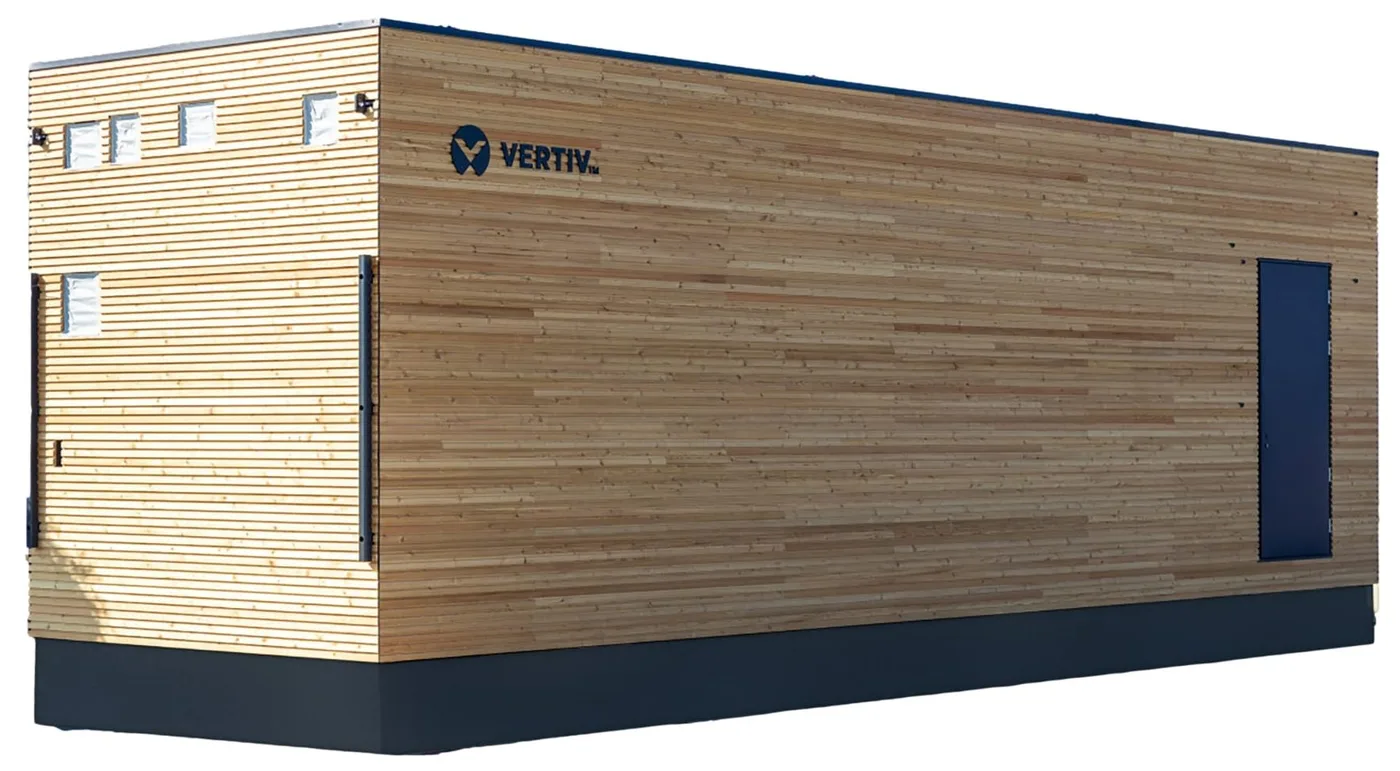
The TimberMod replaces the steel structure of conventional modules with mass timber. Inside, everything stays as proven: the same precision cooling, the same UPS, the same fire protection and the same access control as in the steel version. The difference lies entirely in the construction – and therefore in the carbon balance.
The lever is embodied carbon. Producing steel is exceptionally energy-intensive, whereas mass timber binds carbon as it grows and stores it for the entire service life of the building. For companies reporting under CSRD or pursuing reduction targets of their own, that noticeably shifts how an infrastructure project is assessed.
The power range matches that of the SmartMod and runs from 3 kW for edge installations up to 1 MW. The decision between the two models is therefore not a technical one but a strategic one.
Where the TimberMod is the right choice
- With binding climate targets Where reduction targets are set internally or reported externally, timber construction delivers a measurable contribution rather than a statement of intent.
- With reporting obligations under CSRD The construction acts on Scope 3 emissions and can be stated concretely in sustainability reporting.
- In tenders with sustainability criteria Environmental criteria feed into the scoring in public procurement and, increasingly, in the private sector – here the construction is a direct advantage in the evaluation.
- When the technology must not suffer Inside, the TimberMod is a full data center. Sustainability is not traded off against availability or security.
Key technical data
| IT capacity | 3 kW – 1 MW, depending on build stage |
|---|---|
| Construction | Load-bearing structure in mass timber instead of steel |
| Cooling | Redundant precision cooling |
| Power supply | UPS integrated, backup generator optional |
| Fire protection | Early fire detection with suppression system |
| Security | Access control, remote monitoring via Smart Control |
| Network connection | Fiber, 5G or LTE |
| Availability | Manufactured to order |
| Available as | Rental or purchase |
Standard equipment
These components are part of every system – all you provide is the footprint, a power connection and network access.
- Redundant precision cooling with environmentally friendly refrigerants
- Uninterruptible power supply (UPS), with a backup generator on request
- Early fire detection and suppression system
- Access control and remote monitoring via Smart Control
- Network connection via fiber, 5G or LTE
- Optional: server racks, cabling, PDUs and complete IT hardware
Typical deployment scenarios
- Expanding data center capacity while a reduction program is running
- Replacing a server room whose energy performance is no longer defensible
- Edge sites at companies with a consistent sustainability strategy
- Projects in municipalities and public institutions with environmental requirements
- Sites where the external appearance of the building matters
What timber means for fire protection
The most common objection concerns fire protection – and it rests on a misconception. Mass timber behaves predictably in a fire: it forms a char layer that protects the cross-section beneath it, so it loses its load-bearing capacity slowly and predictably. Steel, by contrast, loses its strength comparatively abruptly at high temperatures.
Independently of that, fire protection in the TimberMod is the same as in every other module: early fire detection and a suppression system are integrated ex works and designed to detect and suppress a fire long before the structure would be affected at all.
Assess the TimberMod for your project
We will work through the configuration and its effect on your carbon balance together with you – without obligation and with a clear comparison against the steel version.
Frequently asked questions
Is a data center built from timber fire-safe?
Yes. Early fire detection and a suppression system are integrated ex works, identical to the steel versions. Mass timber also behaves predictably in a fire: it forms a protective char layer and loses its load-bearing capacity more slowly and more predictably than steel does at high temperatures.
Does the technology differ from the SmartMod?
No. Cooling, UPS, fire protection, access control and remote monitoring are identical. The difference lies solely in the load-bearing structure and therefore in the carbon footprint of the system.
How does timber construction affect sustainability reporting?
The construction reduces the embodied carbon of the system, because energy-intensive steel production is avoided and timber binds carbon as it grows. For companies with reporting obligations under CSRD, this can be stated concretely as part of the Scope 3 assessment.
Is the TimberMod suitable for outdoor installation?
Yes. The structure is designed for permanent siting in the open, including weather protection. The requirements for footprint and site access match those of the other modules.
Are there any limits on capacity?
No. At 3 kW to 1 MW, the power range matches that of the SmartMod. The decision between the two models is not a technical one but a strategic one.